I'm sorry for the lack of posts lately, guys. Every time I've tried to write it's just... fizzled out. Honestly, it just feels as if my brain is full of fog at the moment. But you're not here to read about that.
When I was a little kid I had a fantasy of one day taming and riding a zebra. As I grew up I came to realise that part of the beauty of the zebra is their wild and free nature, and whilst my fantasy faded my love for these equines has continued down to this day. A small collection of model zebra has slowly built up on my shelves, and when I saw Schleich's zebra family I knew that one day I'd like to add them to my little herd.
The stallion and foal came to me second hand as part of a lot of other Schleich animals from a seller. Once I'd bought them I set about looking for the mare to complete the family.
I'd actually gone into the last shop that sells Schleich models in my town (that I know of, at least) looking for Schleich cats when I saw her. There were no cats on the shelves, but there was a lone zebra mare.
She was in pretty good condition for a shelf model, so I seized the chance and bought her. I like the fact that Schleich's zebra actually look like real zebra, and I think the brown shading is a really nice extra detail. I'd have liked more realism in their face stripes, though.
As you can see from her off side, my mare has a few painting flaws. Truth be told, though, I actually really like the spot on her back. It may not be realistic, but it definitely gives her character :)
You can't see from the photo, but she does have small udders, and I like that her hooves are carved underneath.
Daddy and baby arrived the next day. The stallion's face is less well painted than the mare's, and sculpted a bit too narrow in my opinion. But I like the fact that he's a different sculpture, not just the same mould with male parts.
Like his mate he's also got gentle brown shading on his mane, tail and hooves. There's something very solid and wise about this guy, like he's lived on the open plains all his life and he's got the skills and the strength to protect his family from anything that threatens them.
His hooves are also carved out underneath, and I like the gentle flick to his tail, as though it's blowing softly in the Serengeti breeze.
Last up is their little baby, who has got to be one of the cutest foals I have ever seen!
Whilst the other babies are bounding around and getting up to mischief, this little girl seems shy and nervous of the bustling crowds. Probably only a few days old, she hasn't yet got the confidence to venture far from Mama's side.
Just like Mum and Dad, baby has gentle brown shading on her hooves and top line, and she's got just the sweetest little face imaginable. Her legs are a bit thick, and her hooves and fetlocks lack definition, but that little face more than makes up for it.
Unlike her parents, baby's hooves aren't carved underneath, which seems a little odd. Maybe this mould was sculpted before the others, I don't know. But it's a minor issue on an otherwise adorable model.
I haven't come up with any names for these guys yet. I tried looking for inspiration on zoo and wildlife park websites, to see what they named their real zebras, but so far all the sites I've looked at haven't listed their animals' names. It seems fitting to give them authentic African names, so I'll probably just have to keep looking until I find anything that suits them.
Wednesday, 27 January 2016
Wednesday, 13 January 2016
Breast Cancer Benefit Stablemate
Ordinarily, I'm not a big collector of decorator, or unrealistic, model horses. That doesn't mean I don't like them: in fact, some are really beautiful, and I think it's inspired to use a model horse instead of paper as a canvas for art. But with limited space on my shelves, and many of Breyer's decorator models being somewhat more expensive than regular runs, I haven't fallen enough in love with many to want to add them to my collection.
Like many other Breyer collectors, I started with Stablemates. They were small so they didn't take up much room, and relatively inexpensive enough that I didn't feel guilty spending money on them. I liked the fact that, despite their size, they were still quite realistic, and they were similar enough in scale to my Schleich horses that I didn't feel completely out of my comfort zone with them. Of course, Stablemates are like Pringles: it's impossible to have just one! So I bought myself a bunch of models, and, probably more through availability than anything else, ended up buying this guy too.
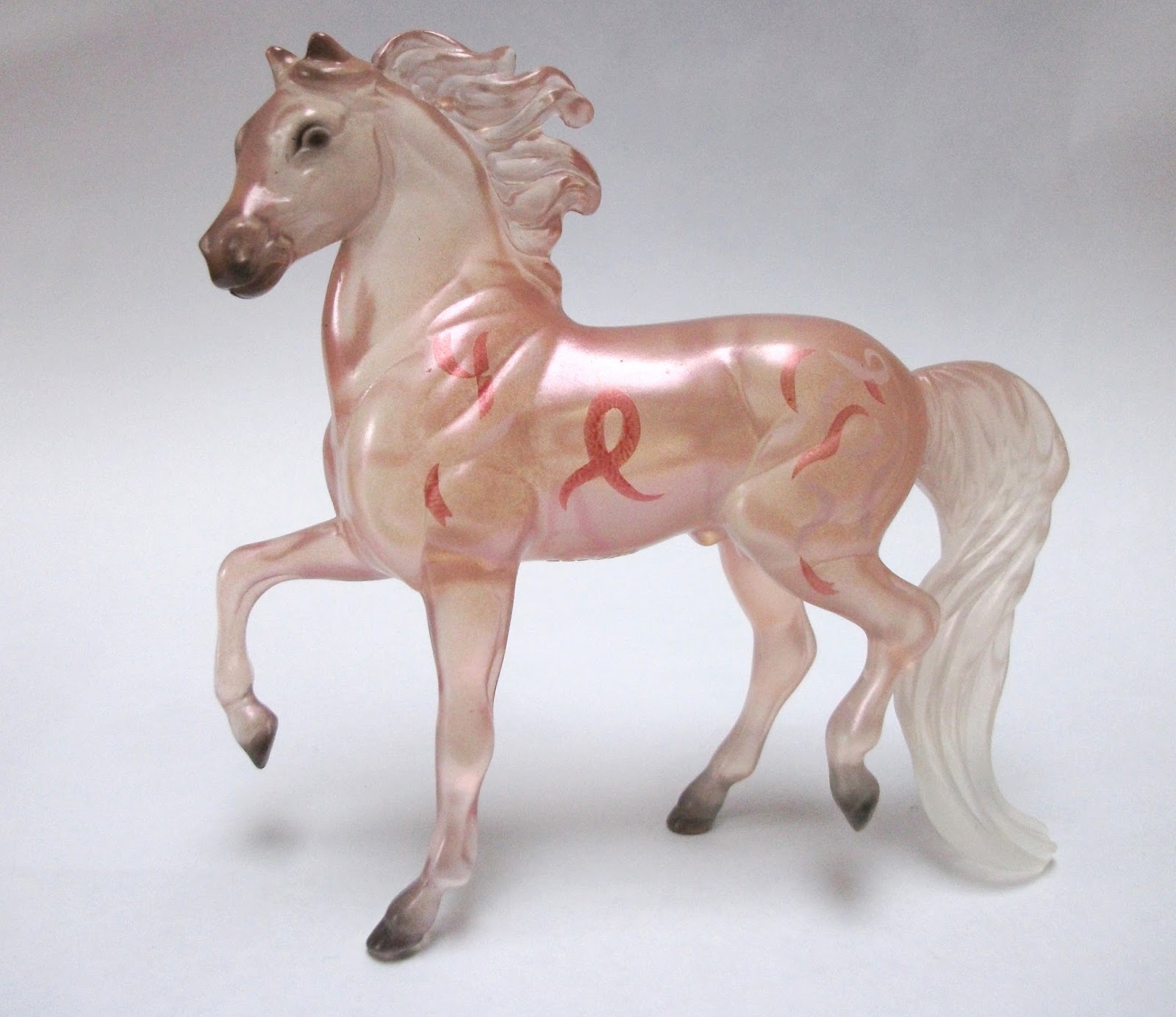
He's the 2010-2012 Breast Cancer Benefit model, otherwise referred to as the Pink Ribbon Stablemate. Breyer has so far produced 3 different Breast Cancer Benefit model runs: one on the Traditional Andalusian Stallion mould, one on the Traditional Bluegrass Bandit mould, and this one on the Stablemate Prancing Morgan stallion mould. All 3 horses are inspired by the famous pink ribbon campaign to raise awareness of breast cancer, hence the pink colouring with pink and white ribbons on their bodies.
I probably bought this stallion mostly because part of the money from the sale of each model was donated by Breyer to the Breast Cancer Research Foundation. Other than that, he was just another pretty Stablemate to add to my collection. But he very quickly grew on me and has unexpectedly become one of my favourite models. I just love him: I can't explain why.
Unfortunately he's ridiculously difficult to photograph! For a start, he is the most tippy model I own. Although I adore it, the Prancing Morgan mould is already prone to instability due to having 2 hooves off the ground. But add to that the fact that my stallion has his foreleg bent too far out and I have to prop him up under his hind leg to even get him to stand upright! And because he's made of translucent plastic instead of the ordinary plastic Breyer uses for their models, the trick of heating the plastic to bend it back into position simply doesn't work for him.
It's not immediately obvious, but his colour is actually stronger in his body and fades out to almost clear on his lower legs and tail. He just looks like an exquisite glass horse.
I said at the start of this post that I don't normally collect decorators, and indeed Courage is my first and so far only one. But he's introduced me to a whole new sub-genre of models, and I'm very quickly falling in love with Breyer's Horse Crazy decorator Stablemates. They're much simpler than my boy, and lack any shading on their eyes, nose or hooves to pick them out. But I think Courage might just like a little herd of translucent horses to keep him company. I think he'd probably be the leader of the herd, though :)
Like many other Breyer collectors, I started with Stablemates. They were small so they didn't take up much room, and relatively inexpensive enough that I didn't feel guilty spending money on them. I liked the fact that, despite their size, they were still quite realistic, and they were similar enough in scale to my Schleich horses that I didn't feel completely out of my comfort zone with them. Of course, Stablemates are like Pringles: it's impossible to have just one! So I bought myself a bunch of models, and, probably more through availability than anything else, ended up buying this guy too.
He's the 2010-2012 Breast Cancer Benefit model, otherwise referred to as the Pink Ribbon Stablemate. Breyer has so far produced 3 different Breast Cancer Benefit model runs: one on the Traditional Andalusian Stallion mould, one on the Traditional Bluegrass Bandit mould, and this one on the Stablemate Prancing Morgan stallion mould. All 3 horses are inspired by the famous pink ribbon campaign to raise awareness of breast cancer, hence the pink colouring with pink and white ribbons on their bodies.
Unfortunately he's ridiculously difficult to photograph! For a start, he is the most tippy model I own. Although I adore it, the Prancing Morgan mould is already prone to instability due to having 2 hooves off the ground. But add to that the fact that my stallion has his foreleg bent too far out and I have to prop him up under his hind leg to even get him to stand upright! And because he's made of translucent plastic instead of the ordinary plastic Breyer uses for their models, the trick of heating the plastic to bend it back into position simply doesn't work for him.
Which brings me to my second point. Because his body is clear, my basic camera really struggles to photograph him. It's a battle to even get it to focus on him, and then half the time it blurs his features anyway. I'm sure a better camera would probably work more effectively, but I've got to make do with what I've got. So just taking pictures of this guy can turn into a real headache.
Despite that, I still adore him. His mane reminds me of moulded glass, and he's got a subtle metallic shimmer to his body. His eyes, nose, inner ears and hooves have been airbrushed so they stand out from the rest of his features, and the ribbons on his body add interest to what would otherwise have been a very plain coat.It's not immediately obvious, but his colour is actually stronger in his body and fades out to almost clear on his lower legs and tail. He just looks like an exquisite glass horse.
When I originally got him I thought it was a bit odd that Breyer had chosen a stallion to represent the fight against breast cancer. Surely a mare would be more suited for the model? Plus, pink is not a very masculine colour for a stallion. But the more I thought about it the less I felt it mattered. Breyer chose a mould that was spirited and elegant, beautiful and strong to represent the fight against breast cancer, and I think they chose well. Besides, breast cancer can affect men as well as women, so maybe a stallion can help to raise awareness that men can suffer too?
Maybe I like this guy so much because I can just feel the power and spirit in him. He's so majestic and lively that it feels as if nothing can stand in his way. Breyer wanted their model to symbolise hope, and I think he does just that. So I decided to name him Courage, and his show name is The Strength to Carry On.I said at the start of this post that I don't normally collect decorators, and indeed Courage is my first and so far only one. But he's introduced me to a whole new sub-genre of models, and I'm very quickly falling in love with Breyer's Horse Crazy decorator Stablemates. They're much simpler than my boy, and lack any shading on their eyes, nose or hooves to pick them out. But I think Courage might just like a little herd of translucent horses to keep him company. I think he'd probably be the leader of the herd, though :)
Thursday, 7 January 2016
Breyer Classic Haflinger Mare
This girl actually arrived before Frankel, but he was much too impatient to wait his turn :)
So, you may remember I recently talked about the Breyer Classic Haflinger mare and how I'd like to add her to my collection. Not long after that post I found one being sold second hand with good reference photos, and decided to go for it. The photos made her colouring look nicely subtle, but I didn't get too excited until I saw the model with my own eyes. After all, online photos of models can be vastly different to real life, for many reasons, such as lighting, background, editing etc.
My new mare arrived promptly, and I was quietly happy with the outcome. She was a lot like her sales photo. Despite the fact that she's Classic scale I'd expected her to be bigger, for some unknown reason, so I was a little surprised at her size. But that's just me being weird :)
At the same time, I can completely see this mould pulling a pony trap on a quiet drive out, bringing home a hunter's deer strapped to her back or walking behind another horse as a pack pony. And there's no doubt she'd make an excellent broodmare, probably one who's already had a couple of foals and is well experienced in rearing youngsters by now. She just so wonderfully diverse.
It's really nice to see a slightly older mare in Breyer's lineup. I'm no expert when it comes to ageing horses, but I'd probably say this girl is in her early to mid teens, based on how she's sculpted. I certainly wouldn't call her a young mare, but she's not yet an old lady either.
I've seen photos of some models with quite poor over-spray on their forelocks, but my girl seems very well painted. Maybe it's just less noticeable on a subtler chestnut.
She's got a gorgeous long mane and tail, and I love the fact that her mane looks a little tousled and thick, just like a real native pony. The slight feathering on her fetlocks is also a nice touch.
I like the fact that she's got shading and isn't just a flat chestnut. I like the darker colouring on her knees and hocks, and it's really nice that as well as the grey on her muzzle, she also has grey shading around her eyes, ear tips and even her 'mare parts'!
That's right! Whilst Breyer's stallions and geldings have been anatomically correct (for the most part) for years now, this is the first Breyer mare I've seen with a suggestion of udders between her legs. Now, they're not much, just a couple of bumps in the mould, but it's clear that they're intentional and certainly a step in the right direction.
I appreciate that Breyers are often given to younger children to play with, and there are parents that are uncomfortable with their kids' plastic animals being anatomically correct. But I personally think that stallion parts are far more explicit than mare's udders. On the other hand, there may be a problem with the injecting moulding process that makes it difficult to produce mares with udders. If that's the case then maybe this is the first sign that Breyer are working out how to overcome that problem? I know I appreciate that little extra touch of realism, and hope it continues in future moulds.
Normally I wait until I've got the model in my hands and can see it with my own eyes before I choose a name for them. But this time I had a name already picked out for this girl. I've called her Gypsy, after a palomino Welsh Cob mare I saw in a pony magazine when I was a child. It was the very first time I'd come across 'gypsy' being used as a name for an animal, and I thought it was really pretty. And whilst my mare isn't palomino or a Welsh Cob, she reminds me of the photo I saw all those years ago, and I think the name suits her.
Of course, now that I have the gorgeous mare I'm finding myself drawn to her cheeky little colt. The palomino from the Pet Groomer set would probably work best as her baby, colour wise (I'd just call him a very light flaxen chestnut). But the bay tobiano from the Colourful Foals set is just stunning! I'm having a real struggle trying to decide whether to get him (and his filly friend) or not, especially as I don't have a very good mother for him. I don't know whether I'd call him a Haflinger x (and say he got his colouring from his father), or have him be an orphan with Gypsy as his foster mum... Anyone got any ideas or suggestions?
Thursday, 31 December 2015
Fun with Head Collars
I've been really getting into making my own model horse tack at the moment. Nothing fancy or elaborate, just rugs to protect my models on their shelves, and head collars. In the past all my model head collars were either official brand or from other tack makers, but I've always wanted to make my own head collars. I just never had the right materials and equipment, and, to be completely honest, I still don't. But I have a box full of ribbons and beads and all sorts of things I've saved for the day when they'll come in handy, and I was going through it the other day and decided it was time to have a go.
I used this tutorial from TiME Stables and Studio's blog to make the rope halter. It seemed a bit complicated at first, but once I started to follow the steps it was actually very straight forward. I particularly like the fact that this kind of halter doesn't require glue or buckles or jump rings, and once you have your string the right length, there's no more cutting needed either.
On the other hand, this kind of rope halter is rarely, if ever, used for real horses in England, so it feels rather out of place on my models. That's why I chose Scout to wear it: since he's a stock horse it suits him better than one of my sport horses or ponies (at least in my opinion).
The thread is some soft, rolled string I had for many many years that I thought would work well for a rope halter. It was a little shorter than the tutorial recommended, but it just about did the job.
However, I messed up on the final step. Whilst trying to tie the poll piece to the cheek loop I accidentally pulled the cheek loop out. I couldn't be bothered to untie the whole halter and go all the way back to the beginning again so I just tied off the poll piece and left it at that. When I try again I'll make an effort to make it realistic, but for the first go I figured it was good enough.
For the lead rope I just took another piece of string and tied it to the chin loop. I realise this is probably not realistic either, but for now I'm satisfied with it.
The other halter I made was much more complicated and took much longer to construct. The jump rings are actually from an old dangly ear-ring I have that's broken beyond repair. I'm a complete squirrel so instead of throwing things away I hang onto them and store them until the day when they'll come in handy, and that's just what happened with the ear-ring. Thankfully, it was pretty simple to take apart so I could use the rings from it. The ribbon came from my afore-mentioned box, and again I've had it for years.
Unfortunately, I don't have any glue that I was willing to risk using. I'm not sure what kind of glue tack makers normally use, although I've known people to use hot glue guns to make model halters. What I do have, however, are needles and thread, so I sewed the pieces of ribbon to the jump rings instead of gluing them. This took a lot of time, and as you can see, wasn't very successful. Sure, it holds the halter together, but it's not very attractive, and the silky ribbon tended to fray on the edges where it was cut.On top of that, I'd sew a piece in, only to find that I'd mistakenly sewn it on the wrong side, so the end that's folded over is on the top instead of underneath where it wouldn't be visible. I also messed up and sewed the buckle piece onto the wrong side of the halter, but I have seen real life left handed halters, so at least that's not too bad.
Unfortunately my bright pink ribbon ran out before I could finish the halter, so I was forced to use another colour for the poll strap. I chose black since it contrasts the bright pink nicely, and used the black ribbon again for the lead rope so at least there's some symmetry. The buckle was homemade from a chopped up paper clip that I bent into shape.
The lobster clasp for the lead rope also came from a piece of old, broken jewellery. I used the same bright pink thread I'd used on the halter for the black ribbon to try to make the lead rope look like it belonged with the halter.
The overall result isn't very pretty, and it definitely won't win any awards, but as a first try I don't think it's too bad. It'll only be worn by my model on the shelves anyway, so it doesn't have to be perfect. And I've learnt some important lessons for the next one I make (like glue is way better than thread!).
Overall it was a lot of fun, and I definitely want to make more head collars in the future. Maybe in a year or so's time I'll be better and I can compare my first attempts and see how I've grown. It's probably worth investing in proper equipment, though... :)
Thursday, 24 December 2015
Chestnut Ridge Writing Contest 2015
All the way back in August of this year (Was it really that long ago? Wow!) Chestnut Ridge held a writing contest for readers of their blog. The challenge was to write an article under the title 'What the Model Horse Hobby Has Done For Me', with the aim of encouraging new people to join the hobby. It seemed like an interesting challenge, and since I enjoy writing I thought it would be fun to give it a go. I thought long and hard over what to include in my article, and carefully planned everything out, and I have to say I thoroughly enjoyed writing my entry. It was worth entering just for the enjoyment of writing alone :)
The closing date came and went, and by November the judging had been done and the placings announced. And I was astounded to discover that my entry had been chosen as the winner of the 18+ year group! I was speechless. I had hoped to place maybe 3rd or even 2nd, but to be first was more than I could ever have hoped for. It was like a dream.
I promptly contacted Chestnut Ridge and asked permission to write about the contest and my placing on this blog, and they said yes. But I was worried that it would seem big-headed to announce it here, so I held back. On the other hand, it seemed ungrateful not to acknowledge such a wonderful honour. Finally, I decided that the best way to write about it would be either when my Breyer Traditional contest prize arrived, or when my article was available to read on the Chestnut Ridge website. I'm afraid you're going to have to wait a little longer to read my article, but I can now reveal my prize model to all those of you who'd like to see him.
So, please meet Frankel. I'm sorry for the photos, but the lighting today was so bad I had to use my camera's flash. But I knew you'd want pictures, so here he is.
Aside from being a Breyer Traditional, the prize model was a complete mystery. So I was delighted to open the box and find Frankel waiting to gallop out of his packaging! I'd admired this stallion since he was released, but since shelf space is extremely limited for me I hadn't purchased him. Now I'm really happy I didn't :)To be honest I'm not a great follower of horse racing, although I had heard of Frankel. I was attracted more to the wonderful rich bay coat, crisp white socks and unique facial markings on this handsome guy. I think red bays with four white feet and facial markings are really striking, and this model is definitely a striking boy. He's also my first on the Smarty Jones mould.
I just love the dynamic energy captured in this mould. He really feels like he's barrelling down the green towards the finish line. It's a really nice touch that Breyer painted the base green for this model, since English Thoroughbreds race exclusively (I believe) on grass tracks. And since the real Frankel is an English racing legend, it's only fitting that he's on an English racecourse.
I haven't decided yet what I'm going to name my new stallion. Normally, I wait until after I've named them to feature them in a blog post, but this guy just couldn't wait. Well, with a pose like that would you expect him to be patient? :)
I love the way his tail flicks up at the end. I love the way there's a little gap in his mane where the hair is whipping around. I love the way his ears are back, listening to his rider and the rest of the field.
I know this model is normally used as a stock horse by live showers, since it's a bit on the stocky side for a racing Thoroughbred. But since I don't show my models I'll probably call him a retired racehorse, perhaps around 10 years old or so. With that grass base he works just as well galloping around his field as charging down a race track.
His face has an interrupted stripe, snip and unusually shaped star. I love unusual facial markings in horses: I feel it gives them character, and makes them truly unique. His star kind of reminds me of a papyrus fan, or maybe a speech bubble in a comic book...
I hadn't realised this from just looking at side photos of other hobbyist's models, but the base is actually hollow. This probably helps to make it more light weight.
I'm sorry the pictures aren't great. He's got much nicer shading in real life.
Just like the real stallion, the model has ermine spots on his hooves. And each hoof on the mould is carved to resemble a real hoof.
I'm going to have to find a suitable name for this gorgeous boy now, and then I've got the task of trying to find him a space on my shelves. But I'm absolutely delighted with him, and so very grateful to Chestnut Ridge for my new model and for hosting their writing contest. I can't wait to read all the other winning articles :)
Subscribe to:
Posts (Atom)